
COSMETICK: a toxicological database and a digital cosmetic risk assessment tool
Updated: Jan 13
COSMETICK is a toxicological and ecotoxicological profile database, combined with a digital cosmetic risk assessment tool. It is designed to support toxicologists and safety assessors in the preparation of Cosmetic Product Safety Reports (CPSR), as well as in the safety assessment of ingredients, impurities, raw materials and fragrance compounds or fragrance concentrates.
COSMETICK enables the structuring, documentation and use of reliable toxicological data, and their direct application in cosmetic risk assessments compliant with European and international regulatory requirements.
COSMETICK: a database, a risk assessment tool… or both?
Having access to a structured toxicological profile database has become essential for the organisation of any safety assessor’s work. To meet the needs of CEHTRA’s own safety assessors, toxicological profiles were originally structured and written to be directly used in safety assessments. In parallel, and because risk assessment is a core requirement for safety assessors, COSMETICK was designed with CEHTRA toxicologists as a digital tool supporting cosmetic risk assessment for finished products and raw materials.
COSMETICK in numbers: a structured toxicological knowledge base
As of the end of December 2025, the COSMETICK database included:
toxicological profiles for 3,400 ingredients,
800 impurities,
500 fragrance substances,
and 1,900 ecotoxicological profiles.
The 3,400 raw materials included are either documented by CEHTRA for its users or entered directly and confidentially by the users themselves.
Each toxicological profile results from a rigorous and standardised process involving data collection, selection of relevant studies, and synthesis of results for all endpoints required for cosmetic risk assessment. Results are described for nine toxicological endpoints: skin and eye irritation, skin sensitisation, phototoxicity, acute toxicity, sub-chronic or chronic toxicity, reproductive toxicity, endocrine disruption, and carcinogenicity. Dermal and oral absorption data are also documented. Data gaps are clearly identified and visualised through colour-coded icons.
The data are derived from numerous recognised scientific sources (SCCS, CIR, ECHA opinions, EFSA, US EPA, etc.), as well as from peer-reviewed scientific literature and in silico approaches. All sources are precisely referenced.
Ecotoxicity is documented in accordance with REACH and CLP/GHS requirements, including PBT/vPvB assessment. It covers biodegradability (OECD, BIOWIN), bioaccumulation (BCF, log Kow), and acute and chronic aquatic toxicity (algae, daphnia, fish), complemented by recognised QSAR models (ECOSAR). The analysis follows a weight-of-evidence approach integrating measured data and literature.
Profiles are continuously updated based on several criteria:
regulatory and toxicological developments,
human health concerns identified during user safety assessments,
and frequency of profile use.
Successive versions are retained for each profile, with documented comparisons between versions, ensuring traceability of updates and methodological consistency. For risk assessment purposes, cosmetic product types and exposure scenarios can be selected from predefined categories in line with standard safety assessment practices.

Developed by toxicologists, used in production at CEHTRA
COSMETICK was initially developed as an internal tool at CEHTRA for the preparation of Cosmetic Product Safety Reports from 2018 onwards. Designed by and for toxicologists, it was made available online in 2021 under a licensing model:
COSMETICK BASIC, providing access to the toxicological profile database,
COSMETICK ADVANCED, providing full access to the database and to cosmetic risk assessment functionalities.
The coexistence of the internal CEHTRA tool and the online user version ensures that users benefit from all improvements identified by CEHTRA toxicologists for their own daily practice. These improvements stem from practical needs (export formats, colour-coded user-friendly displays, formula duplication) as well as methodological developments (reverse calculation for raw materials, QRA2, results by IFRA categories). As a result, users can be confident that their cosmetic risk assessments incorporate the most up-to-date scientific and methodological approaches that digital automation can support. Data personalisation further ensures that each assessment remains specific to the company’s choices and practices.
What does a toxicological profile look like in COSMETICK?
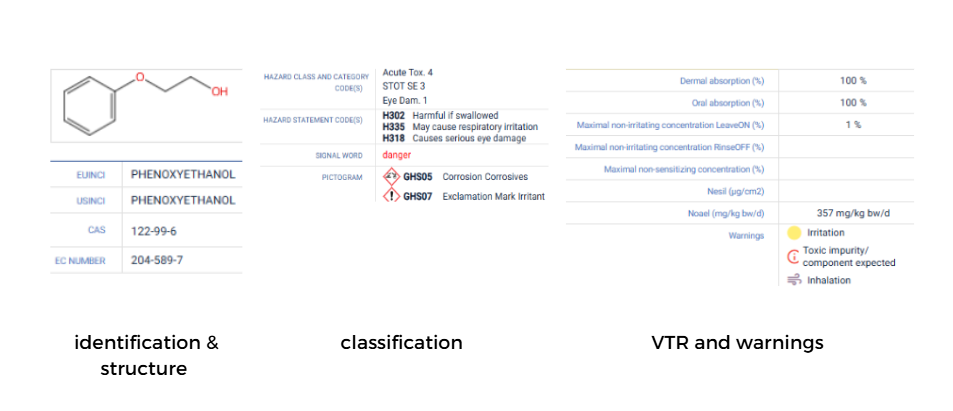
A toxicological profile in COSMETICK includes full substance identification (INCI name, synonyms, CAS number), relevant toxicological data, toxicological reference values, colour-coded warnings, and a structured scientific summary.
For each endpoint, the profile summarises study results, identifies critical effects, and provides the toxicological reference values used for risk characterisation: LOAEL, NOAEL, NESIL, and non-effect, irritant or sensitising concentrations. The selected Point of Departure (PoD) is justified. Missing data are explicitly identified to help the safety assessor define appropriate follow-up actions.
Warnings and signals of concern
Colour-coded warnings allow rapid visualisation of critical toxicological concerns and data gaps. They provide a key decision-support tool, enabling the safety assessor to quickly identify potential issues related to a substance, raw material or formulation before assessing the actual risk based on concentration and intended use. Ecotoxicological profiles are also ranked according to increasing levels of concern.
Example: a preservative
Phenoxyethanol (CAS No. 122-99-6) is authorised as a cosmetic preservative under the European Cosmetic Regulation, up to a maximum concentration of 1%. Based on CEHTRA’s experience over the past four years, it is the most frequently used preservative.
Phenoxyethanol has a broad antimicrobial spectrum, effective against Gram-negative bacteria (e.g. Pseudomonas aeruginosa), Gram-positive bacteria (Staphylococcus aureus), and yeasts (Candida albicans). Its activity is attributed to inhibition of microbial DNA/RNA synthesis and increased cell membrane permeability.
In 2016, the SCCS evaluated systemic effects and concluded that phenoxyethanol is not classified as reprotoxic and is only a rare skin sensitiser, considering it one of the best-tolerated preservatives. Systemic toxic effects were observed only at oral or dermal exposures approximately 200-fold higher than consumer exposure levels from cosmetics. Consequently, the SCCS concluded that phenoxyethanol is safe for all consumers, including children of all ages, when used up to 1%.
Although its irritant properties are well established, it remains well tolerated at authorised levels, without inducing skin irritation or sensitisation. Some rare discomfort reactions (stinging, tightness) may occur, particularly in cases of co-exposure with other irritants. This illustrates the importance of the safety assessor’s expertise, which goes beyond bibliographic data to evaluate safety under realistic conditions of use, such as daily facial application. While such discomfort does not represent a major health risk, it is typically undesirable for both consumers and brands.
Phenoxyethanol is classified as STOT SE 3 (H335: May cause respiratory irritation) under CLP Regulation No. 1272/2008. Very rare cases of allergy have been reported and must be assessed case-by-case depending on population, skin type and product type.
The substance is neither phototoxic nor genotoxic and shows low acute toxicity. Systemic toxicity is characterised by a sub-chronic study identifying a NOAEL of 500 mg/kg bw/day (357 mg/kg bw/day for daily administration), which adequately protects against reproductive effects observed at higher doses (SCCS, 2016; Api et al., 2025).
Available receptor binding studies do not suggest endocrine activity. Nevertheless, attention remains warranted pending conclusions from ECHA, which included phenoxyethanol in its Endocrine Disruptor Assessment programme under the Biocidal Products Regulation (assessment ongoing as of 21 August 2025).

From ingredient to finished product: risk assessment in practice
Example 1: cosmetic product with a risk of skin sensitization
The product assessed is a facial sunscreen used daily. It contains the colourant CI 77288. Several cases of allergy have been reported in the literature for various chromium(III) oxides, as highlighted by CORAP in 2022. In the absence of specific skin sensitisation characterisation, and particularly of quantitative data, the risk of sensitisation at 0.1% cannot be excluded. The risk is considered likely, leading to an unfavourable safety conclusion.
Example 2: cosmetic product with insufficient MOS
In a product intended for infants, caprylyl glycol is used at 0.5%. The associated Margin of Safety is insufficient, indicating a probable risk of systemic toxicity. The NOAEL is derived from a sub-chronic OECD 408 study. At higher doses, developmental effects may occur and are currently under regulatory scrutiny, potentially leading to harmonised reprotoxic classification (ECHA ARN on 1,2-ethanediols and their carbonates, 2021). Thus, although the Margin of Safety based on a robust toxicological reference value is insufficient, additional concerns are flagged by the “Reprotoxicity” and “Irritation” warnings. At the assessed concentration, irritation is not expected, and lower exposure levels would be considered safe and can be readily calculated.
COSMETICK and international regulatory requirements
COSMETICK toxicological profiles are prepared in accordance with Annex I of the European Cosmetic Regulation (EC) No. 1223/2009 and SCCS recommendations for CPSR preparation. This methodology reflects principles widely recognised at the international level. For example, China’s CSAR regulation requires documented safety justification based on comprehensive toxicological profiles covering all relevant endpoints. Similarly, the US Modernization of Cosmetics Regulation Act (MoCRA) requires safety substantiation based on reliable and relevant toxicological data for each ingredient. COSMETICK fully aligns with this international approach to cosmetic risk assessment.
Licences and access to COSMETICK
R&D and toxicology teams may limit their needs to consultation of toxicological profiles, available through COSMETICK BASIC. More comprehensive needs — including finished product risk assessment, raw material use evaluation or fragrance concentrate assessment — are addressed through COSMETICK ADVANCED.
Confidential raw materials can be integrated, and users may also include their own toxicological data to personalise reference values.
References
COSMETICK: an established reference for digital cosmetic risk assessment
COSMETICK is a reference digital tool for cosmetic risk assessment, combining a structured toxicological and ecotoxicological database, a robust scientific methodology and decision-support functionalities. It is designed to sustainably support toxicologists, safety assessors and R&D teams in an ever-evolving regulatory landscape.
Discover how COSMETICK integrates with the regulatory requirements of the cosmetics market.
Contact our toxicology experts to discuss your cosmetic risk assessment needs.
Author: Clarisse BAVOUX
